Rungli Rungliot
The Lama Who Stopped the Teesta
Long before the Darjeeling hills had tea gardens, roads, railway lines or tourists, there was a great flood.
The Teesta had risen in the mountains.
The water kept rising and rising, pouring down the Himalayan valleys until villages below were threatened with destruction. People watched helplessly as the river spread across the land.
There was, however, a lama meditating in a temple high on one of the mountain ridges.
The desperate villagers went to him.
They told him that the Teesta would not stop.
The lama listened.
Then he told them to order the river to go down.
They were astonished.
How could anyone command a river?
The lama came out of his prayers and went towards the flood. He raised his hand towards the raging water and spoke:
Rungli Rungliot.
Thus far and no further.
The flood stopped.
The water began to fall.
The villages were saved.
Whether this is an ancient memory, a local legend or simply a beautiful story created to explain the name of a place, nobody can say with certainty. But the words survived.
And eventually they became the name of a small settlement in the Darjeeling hills:
Rungli Rungliot — thus far and no further.
It was here, or rather a little below it, that an English writer came to live during the Second World War.
Her name was Rumer Godden.
And the year she spent in these mountains became one of the most evocative literary portraits ever written of the Darjeeling Himalayas.
A writer disappears into the hills
By 1941, Rumer Godden was already a successful writer.
She had spent much of her childhood in India and had returned to Calcutta as a young woman. She ran a dance school, married and had two daughters. Her novel Black Narcissus, published in 1939, had made her internationally known and would later become the celebrated Powell and Pressburger film.
Then her personal life became difficult.
Her marriage was effectively breaking down; her husband had left to join the Army, and the Second World War had transformed life in India.
Godden did something that sounds almost unbelievable today.
She left Calcutta.
She took her two young daughters with her, along with their Swiss governess, Giovanna, several servants and four Pekinese dogs.
She went into the mountains.
Not to the fashionable centre of Darjeeling, but much further away from the bustle of the hill town.
She rented a bungalow at Chinglam, on a tea estate, in the hills above the Teesta valley. Chinglam was about seven miles below Rungli Rungliot, and the estate stood in a landscape of steep mountains, forests, streams and tea gardens. Sources differ slightly on the precise distance from Darjeeling, but contemporary descriptions place it roughly 18 miles from the town.
For Godden, it was almost another world.
The war was still raging.
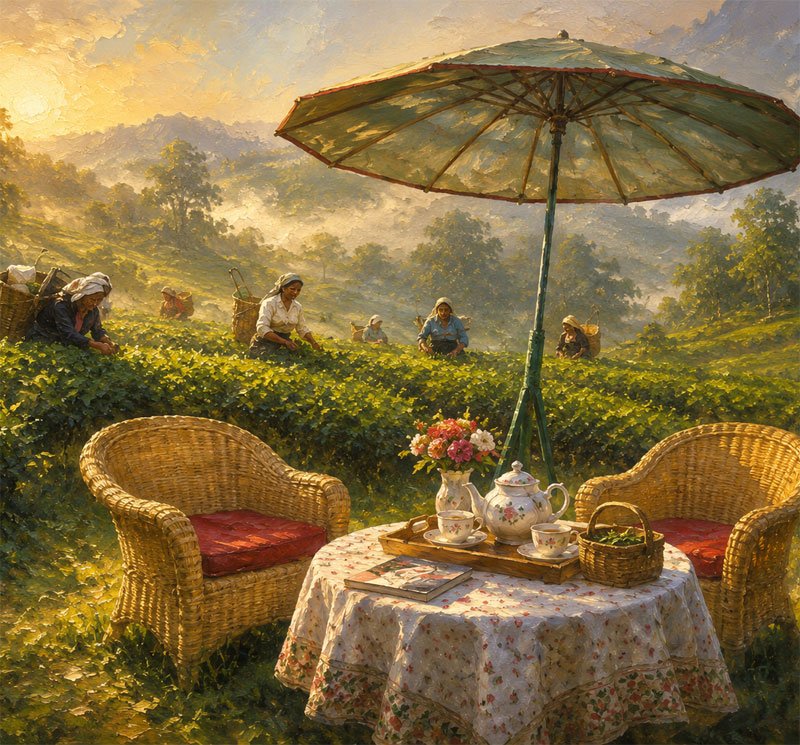
But at Chinglam, life was governed by rain, tea, children, flowers, animals and the seasons.
She began keeping notes.
Those notes would eventually become a book.
Chinglam
Godden’s own description of the book is wonderfully simple.
She said there were only a few things in her notes:
Chinglam and its hills and valleys.
Work.
Flowers.
Children.
Animals.
Servants.
There was nothing else because, she said, there was nothing else.
That sentence explains why Rungli-Rungliot is so different from a conventional travel book.
Godden was not passing through.
She was not collecting picturesque views.
She was living there.
The mountain became her entire world.
Her daughters, the five-year-old Rafael and three-year-old Sabrina, explored the tea garden with Giovanna. The children played with local children, walked down to waterfalls and became accustomed to a life surrounded by mountains.
Godden herself planted a garden.
She watched flowers appear and disappear with the seasons.
She watched the clouds descend into the valleys.
She listened to the rain.
She watched the Teesta.
And she observed the people who made the isolated tea estate function.
One of them was a Lepcha man whom she calls Ears in the book. He was from neighbouring Sikkim and became the head of the household’s servants. Around him were people who carried water, cut wood, washed clothes, tended the house and performed the countless tasks necessary to keep an isolated mountain household alive.
There was even a bread-runner who travelled enormous distances on foot to deal with Godden’s accounts and supplies.
For a modern traveller, this detail is perhaps one of the most fascinating aspects of the book.
The Darjeeling hills we know today are connected by roads, cars, telephones and the internet.
Godden’s Chinglam had none of these conveniences.
If something was needed, someone had to carry it.
If someone wanted to send a message, the message had to travel physically.
If the rain cut the road, the outside world simply disappeared.
The monsoon
And then there was the rain.
Anyone who has spent time in the Darjeeling hills during the monsoon knows how completely rain can take possession of the landscape.
For weeks, the mountains can disappear into cloud.
Paths become slippery.
Streams become torrents.
Everything is wet.
Godden experienced this without the escape routes available to a modern traveller.
The rain was not something she watched from a hotel window.
It controlled her life.
It entered the house.
It affected the roads.
It altered the garden.
It changed the river.
And below the hills, the Teesta became a frightening presence.
Godden describes the river as beautiful but dangerous — a river whose colour and character changed with the seasons. During the rains it swelled into a powerful, threatening body of water; in winter it became clearer and bluer. The local belief that the Teesta had to claim a life from time to time gave the river an almost supernatural personality.
Which brings us back to the lama.
Rungli Rungliot
Goddens book writen here is named Rungli Rungliot – Thus far and no further.
She begins her book with the story of the flood.
The Teesta may be beautiful, but it is not tame.
It may flow peacefully through a valley today and become a destructive force tomorrow.
The old story gives the river a personality — one that must be respected.
And perhaps that is why the legend works so well as the opening to Godden’s book.
She was about to spend a year living beside a river whose presence dominated the landscape.
She had come to the mountains seeking distance from the troubles of the outside world.
But the mountains had their own rules.
A world measured in small things
The great attraction of Rungli-Rungliot is that nothing spectacular needs to happen.
Godden discovers that when life becomes very small, ordinary things become fascinating.
A child appears with a basket of peas.
A flower opens in the garden.
A servant disappears somewhere down the mountain.
The dogs follow the children.
Someone arrives unexpectedly.
A parcel is delayed.
The weather changes.
A cloud lifts and a mountain appears.
These are the events.
There are no grand Himalayan expeditions.
No heroic climbs.
No dramatic encounters with wild animals.
Instead, Godden pays attention to the small details that make a place feel real.
One of the most memorable episodes concerns a young girl who comes to sell peas and vegetables. Godden notices her clothes, her long braided hair and the shy way she stands behind a tree. She buys everything the girl has brought.
It is an insignificant encounter.
Yet decades later, it remains one of the scenes readers remember.
That is Godden’s great skill.
She makes the ordinary memorable.
Children in the mountains
The two girls are at the centre of the book.
Rafael and Sabrina are not simply accompanying their mother.
They are discovering the mountains.
They walk through the tea gardens.
They explore.
They play.
They ask questions that only children can ask.
They make friends.
They learn the rhythms of the place.
And Godden gradually realises something that perhaps would have been difficult to see in the crowded life of Calcutta.
She is seeing her daughters grow up.
The isolation, which at first seems like a burden, becomes an unexpected gift.
There is time.
Time to watch.
Time to listen.
Time to write.
Time to know the children.
The mountains outside the window
From Chinglam, the landscape stretched towards the high Himalayas.
On clear days, the great snow peaks appeared above the nearer hills.
Kanchenjunga and Pandim stood beyond the valleys, enormous and distant.
On other days, they vanished completely.
The clouds came down.
The mountains disappeared.
The world contracted to the bungalow, the garden and the immediate slopes.
Then, sometimes, the clouds lifted.
The Himalayas returned.
This alternation between revelation and disappearance is one of the defining experiences of the Darjeeling hills.
Godden understood it instinctively.
She did not simply describe the mountains.
She described what it felt like to live with them.
The people of the tea garden
The world Godden entered was also colonial.
Chinglam was part of a British-managed tea plantation, and the household depended upon a large number of local workers and servants.
Godden observed them closely, sometimes affectionately and sometimes through the assumptions of a British woman of the 1940s.
That distinction matters today.
Some of her descriptions of local people reflect the attitudes of her period and can feel uncomfortable to a modern reader.
But the book is nevertheless valuable because it records a social world that has largely disappeared.
It shows how a tea estate operated.
It shows the dependence of European households on local workers.
It records names, habits, food, clothing, journeys and small encounters that would otherwise have vanished.
And among the people around Godden were Lepchas, Nepalis and others whose lives were intimately connected with the mountains.
The book therefore offers an accidental glimpse into the human landscape of the Darjeeling hills at a particular moment in history.
A world that has disappeared
Almost everything around Godden has changed.
The British Empire is gone.
The tea gardens remain, but the social world of the colonial tea estate has disappeared.
The roads have changed.
The railway has changed.
The way people travel has changed.
Chinglam is no longer the isolated world that Godden knew.
Even the experience of silence has changed.
Yet the landscape remains remarkably recognisable.
The tea-covered slopes are still there.
The monsoon still arrives.
The clouds still roll through the valleys.
And the Teesta still flows below.
That is what makes Rungli-Rungliot so interesting today.
It is not merely a book about Rumer Godden.
It is a time capsule.
A book almost lost
Godden published Rungli-Rungliot in 1943, with Peter Davies in London. It was later reissued under the title Thus Far and No Further and has been republished in India in a modern edition by Speaking Tiger.
It never achieved the fame of Black Narcissus.
Nor did it become one of the books most commonly associated with Darjeeling.
Yet it acquired devoted admirers.
One of them was Ruskin Bond.
Bond encountered the book while living away from India and was immediately drawn back to the Himalayan landscape he knew. When Rungli-Rungliot was republished in India, he wrote the foreword.
For Bond, the book captured something that was disappearing: a particular kind of life in the mountains, suspended between the world of the British Raj and the India that was about to emerge from it.
What remains of Rungli Rungliot?
Today, the name is still on the map.
Rangli Rangliot lies in the Darjeeling hills, surrounded by tea gardens and mountain settlements.
But the place is easy to pass without noticing.
There is no enormous monument announcing that a famous writer once lived nearby.
There is no great museum dedicated to Rumer Godden.
The landscape does not advertise its literary history.
And perhaps that makes the discovery more rewarding.
You have to know the story first.
Then the landscape begins to look different.
A tea garden is no longer just a tea garden.
A mountain road becomes the route by which a writer travelled into isolation.
A quiet bungalow becomes the possible setting for a forgotten chapter of literary history.
The Teesta becomes more than a beautiful river.
And the name Rungli Rungliot suddenly carries another meaning.
Finding the Rungli Rungliot of Rumer Godden
If you travel through the Darjeeling hills today, look beyond the famous viewpoints.
Look for the old tea gardens.
Look at the narrow roads following the mountain contours.
Watch the clouds gathering over the valleys.
Listen for the sound of water below.
And when you come across the name Rangli Rangliot, remember that there is a story hidden inside it.
A flood.
A lama.
A river that was told to stop.
And, nearly two thousand feet of mountain landscape away from the famous town of Darjeeling, an English writer who came here during a world war and found enough beauty and solitude to fill a book.
Rungli Rungliot.
Thus far.
And no further.
Yet the story travelled much further than the river ever did.