Traditional Cuisine of Darjeeling
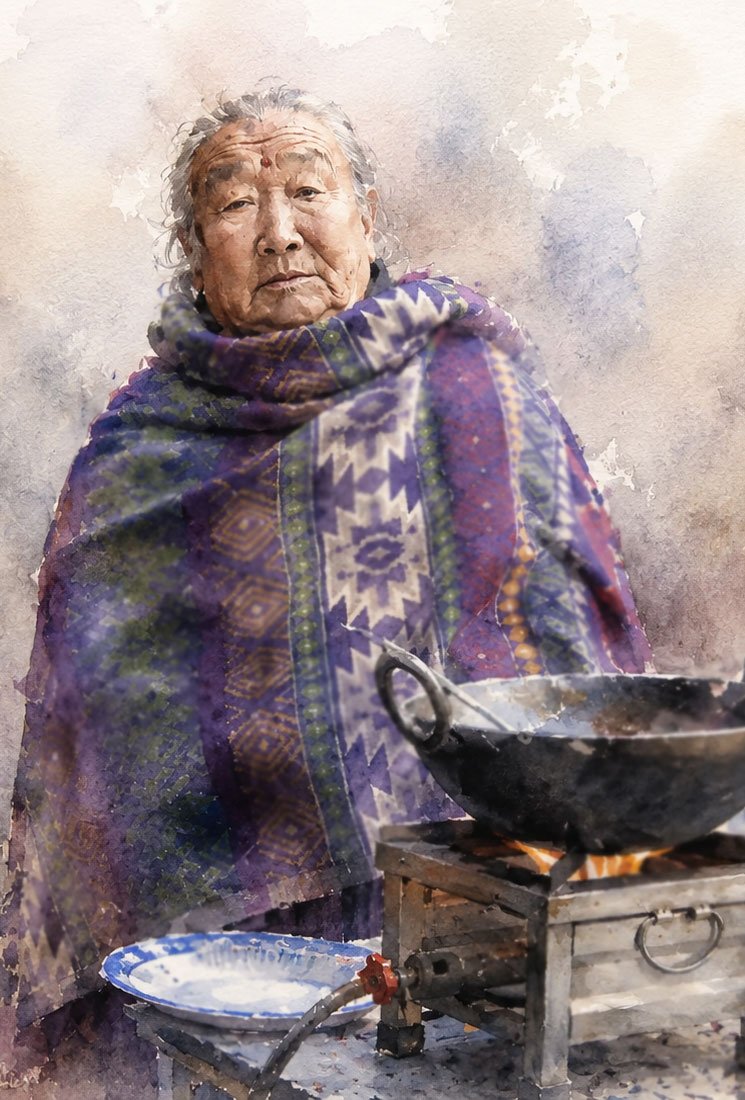
Food, Communities and Flavours of the Eastern Himalayas
Darjeeling does not have a single cuisine.
Its food has developed through the meeting of several communities and traditions — particularly Nepali/Gorkha, Tibetan, Bhutia and Lepcha, together with influences from other communities that have made the hills their home.
Some dishes are now so closely associated with Darjeeling that it is difficult to imagine the town without them. Momo and thukpa are perhaps the best-known examples. Others remain largely part of home cooking, prepared for families, festivals and community occasions rather than displayed on restaurant menus.
There are fermented vegetables, buckwheat and rice breads, bamboo shoots, leafy greens, meat preparations, soups, pickles and simple everyday meals built around rice, dal and vegetables.
What makes the food particularly interesting is that it is not generally about elaborate spices or complicated cooking.
Much of the traditional food of the eastern Himalayas is based on fresh, locally available ingredients, fermentation, steaming, boiling and simple cooking, allowing the character of the ingredients to remain prominent.
And some of the most interesting things to eat in Darjeeling are not necessarily the dishes that appear on a tourist menu.
A Cuisine Shaped by the Hills
Darjeeling’s food reflects its geography as much as its people.
The hills have traditionally provided an abundance of leafy vegetables, bamboo shoots, wild greens and other seasonal ingredients. Rice has long been an important staple, while vegetables, lentils, meat, fermented foods and pickles form much of the everyday diet.
The cooler Himalayan climate also lends itself naturally to foods that are warming and filling: bowls of noodle soup, steamed dumplings, fermented preparations and hot drinks.
At the same time, food traditions travelled with people.
Nepali-speaking communities brought their own methods of preparing rice, vegetables, meat and fermented foods. Tibetan communities brought foods such as momo, thukpa and shaphalay. Lepcha traditions developed around the plants, grains and forest resources of the eastern Himalayas.
Over time these foods became part of the shared food culture of Darjeeling.
That is why it is more useful to think of Darjeeling cuisine as a meeting place of Himalayan food traditions rather than as one fixed culinary tradition.
The Foods Most Visitors Associate with Darjeeling
Momo — Darjeeling’s Favourite Dumpling
Few foods are as strongly associated with Darjeeling today as the momo.
These steamed dumplings are made from a thin flour wrapper and filled with meat or vegetables. They are generally served with a bowl of clear soup and a spicy chutney or achar.
The Darjeeling District administration describes momo as one of the town’s characteristic foods, with both meat and vegetable versions widely available.
The fillings vary considerably.
Chicken, pork, beef and other meats may be used, while vegetarian versions commonly contain cabbage and other vegetables. Different restaurants and neighbourhood stalls have their own proportions, folding styles, fillings and chutneys.
And this is where eating momo in Darjeeling becomes more interesting than simply ordering it from a well-known restaurant.
The town has hundreds of momo shops and stalls, and some of the places most appreciated by local residents are small, unassuming establishments away from the principal tourist streets.
If you want to understand Darjeeling’s momo culture, follow the locals rather than judging a momo shop by its appearance.
A good momo is often a very simple thing: a thin wrapper, a well-balanced filling, a hot steamer and a chutney with enough character to make you reach for another.
Thukpa — A Bowl of the Himalayas
If momo is Darjeeling’s most recognisable snack, thukpa is perhaps its most familiar bowl of comfort.
Thukpa has its roots in Tibetan cuisine but has become deeply established in Darjeeling. The Darjeeling District administration describes it as a hot noodle soup containing vegetables, spices and noodles, and notes its widespread availability throughout the town.
There is no single version of thukpa.
Depending on the cook, it may contain vegetables, chicken, meat or other ingredients. Some versions are light and clear; others are richer and more heavily flavoured.
There are also different Himalayan noodle soups that visitors may encounter under related names, including thenthuk, where hand-pulled or hand-cut pieces of dough replace the more familiar noodles.
On a cold or wet Darjeeling afternoon, a steaming bowl of thukpa makes perfect sense.
It is warm, filling and uncomplicated — exactly the kind of food that suits life in the hills.
Sel Roti — Festival Food and a Taste of Home
Sel roti is one of the foods that reveals the importance of festivals and home cooking in Darjeeling’s Nepali/Gorkha culture.
It is a ring-shaped fried bread made primarily from rice flour. Slightly sweet, crisp on the outside and softer inside, it is particularly associated with festivals such as Dashain and Tihar.
Unlike momo and thukpa, sel roti is not necessarily something you will find being prepared continuously in every restaurant.
It is strongly connected with homes, family gatherings and special occasions.
The Darjeeling District administration’s account of sel roti describes it as part of the region’s shared community food culture and specifically connects it with festivals such as Tihar.
For a traveller, this distinction matters.
Some of the most meaningful traditional foods are not restaurant dishes at all.
They are foods made when families gather.
Gundruk — Fermentation as a Way of Preserving the Hills
One of the most characteristic foods of Nepali Himalayan cooking is gundruk.
Gundruk is made by fermenting leafy vegetables such as mustard, radish or cauliflower leaves and then drying them for later use.
The resulting food has a distinctive sour, earthy flavour and is commonly used in soups, stews and other preparations.
Fermentation is more than a way of creating a particular taste.
In mountain communities, preserving seasonal vegetables allows food to remain available beyond the period when fresh leaves are abundant.
Gundruk therefore tells us something about the relationship between food and the Himalayan environment.
It is a food born from necessity that has become part of culinary identity.
It may be served simply as a soup or combined with other ingredients to produce a stronger, more complex dish.
If you enjoy fermented foods, gundruk is one of the traditional flavours worth seeking out.
Kinema — Fermented Soybeans
Another fermented food associated with the eastern Himalayan food culture is kinema, made from fermented soybeans.
Its strong aroma and distinctive flavour can take some getting used to, particularly for visitors unfamiliar with fermented foods.
But kinema is an important example of how fermentation appears across the region’s food traditions.
It is used in cooking rather than simply eaten as an accompaniment, and is particularly associated with the food traditions of Nepali-speaking communities in the eastern Himalayas.
Alongside gundruk, kinema demonstrates an important characteristic of local cooking:
preservation itself has become part of the cuisine.
Rai Saak — Everyday Food from the Hills
Not everything traditional needs to be unusual.
Rai saak, or mustard greens, is a familiar leafy vegetable in the hills.
It is commonly cooked simply, often with garlic, chilli and mild seasoning, and served alongside rice, dal and other dishes.
Its importance lies precisely in its everyday nature.
Tourists often search for a famous local dish, but traditional food cultures are built around what people eat regularly at home.
Rai saak is one of those foods.
Alongside other seasonal greens and vegetables, it forms part of the everyday cooking that is less visible in restaurant menus but more representative of ordinary household meals.
Alu Dum — A Hill Favourite
Alu dum, a spicy potato preparation, is another everyday favourite in the Darjeeling hills.
Potatoes may seem unremarkable, but in the hills they have become an important part of local food culture.
The Darjeeling District administration specifically lists aludum among the characteristic foods of the hill people.
Alu dum is frequently encountered alongside bhuja, a mixture of roasted or puffed grains and other ingredients, and it can appear as a snack or accompaniment rather than as a formal main course.
It is a useful reminder that local cuisine is not necessarily made up of rare ingredients.
Sometimes a dish becomes traditional because generations of people have made it part of everyday life.
Phaphar — Buckwheat in the Himalayan Kitchen
Buckwheat has long been cultivated and eaten in Himalayan regions, and phaphar, the Nepali name commonly used for buckwheat, appears in several traditional preparations.
One example is phaphar ko roti, a buckwheat bread or pancake.
Buckwheat is particularly suited to mountain agriculture and forms part of the wider food culture of the eastern Himalayas.
Its earthy flavour is quite different from wheat-based breads, and it is worth trying when available.
For visitors interested in understanding local food rather than simply sampling famous dishes, ingredients such as buckwheat can be more revealing than a long restaurant menu.
Bamboo Shoots and Mountain Vegetables
The food of the eastern Himalayas makes considerable use of vegetables and plants that grow in the surrounding landscape.
Bamboo shoots are an important example.
They may be eaten fresh or preserved and fermented, and their distinctive flavour appears in several Himalayan food traditions.
Other seasonal vegetables and wild greens may include ningro, a young fern shoot, and sishnu, or nettle, which is cooked rather than eaten raw.
Such ingredients are especially important in understanding indigenous and rural food traditions, where the distinction between cultivated crops, gathered plants and forest produce is much less pronounced than it is in an urban kitchen.
These foods also change with the seasons.
What appears on a household table in spring may not be available in the same form during winter.
Lepcha Food Traditions
The Lepchas, one of the indigenous peoples of the eastern Himalayas, have their own food traditions closely connected with the landscape of Sikkim and the Darjeeling hills.
Traditional Lepcha cooking makes use of locally available grains, vegetables, bamboo and other plants.
Buckwheat, maize, bamboo shoots and wild greens all have places within the wider Lepcha food tradition.
Among traditional preparations documented in Lepcha food culture are Khu Zom, a thick bread made from millet or maize flour, and preparations involving fermented bamboo shoots.
The importance of these foods goes beyond flavour.
They reflect a way of living in which the surrounding landscape was — and remains — an important source of food.
For travellers interested in indigenous culture, seeking out a genuine Lepcha meal can therefore offer a very different experience from ordering the most famous dishes in a Darjeeling restaurant.
Nepali Food in Darjeeling
The Nepali/Gorkha community has had an enormous influence on the food culture of Darjeeling.
A traditional household meal may be built around bhat (rice), dal, vegetables, meat and achar, with fermented foods and seasonal greens appearing alongside them.
The food can be simple, but simplicity does not mean a lack of flavour.
Garlic, chilli, herbs, fermented ingredients and pickles provide much of the character.
Popular preparations include:
- Gundruk
- Rai saak
- Sel roti
- Alu dum
- Kinema
- Meat curries and preparations
- Various pickles and achars
A traditional Nepali thali can be one of the best ways for a visitor to encounter several of these elements together.
But the best expression of Nepali food is often found not in a restaurant menu but in a household, where the dishes change according to the family, season and occasion.
Tibetan and Bhutia Food Traditions
Tibetan and Bhutia communities have contributed another important layer to Darjeeling’s food culture.
Momo, thukpa and shaphalay are among the foods most closely associated with this tradition.
Shaphalay
Shaphalay is a Tibetan-style fried bread filled with meat.
Unlike the steamed momo, the outer dough is fried, giving it a crisp exterior.
It is often served with other Tibetan foods and makes a substantial snack or meal.
The Darjeeling District administration includes shaphalay among the characteristic foods of the town.
Thenthuk
Thenthuk is another Tibetan noodle soup in which pieces of dough are pulled or cut into the broth.
It is closely related in spirit to thukpa but has a different texture and preparation.
The combination of noodles or dough, broth, vegetables and meat makes these dishes particularly well suited to Darjeeling’s cool climate.
Churpi — Himalayan Cheese
Churpi is a traditional Himalayan cheese made from milk, traditionally associated with yak or cow milk depending on the region and availability.
It exists in different forms, from softer cheese that can be incorporated into food to harder varieties that are eaten slowly.
Churpi is particularly interesting because it represents another way Himalayan communities have adapted food production to their environment.
Dairy products could be preserved and transported more easily when converted into cheese.
Today, churpi can be encountered in various forms in Darjeeling and elsewhere in the eastern Himalayas.
Tibetan Tea — An Acquired Taste
Tea in Darjeeling is usually associated with the famous aromatic black tea produced in the surrounding estates.
But there is another tea tradition in the hills.
Tibetan butter tea is a savoury drink made with tea, butter, salt and, depending on the preparation, milk.
The flavour is very different from the sweet milk tea familiar to most visitors.
The Darjeeling District administration describes Tibetan tea as salt tea mixed with butter and notes its distinctive taste.
It is not necessarily a drink that everyone will immediately love.
But it is worth trying because it introduces another Himalayan food tradition and another way of thinking about tea.
Tongba — A Traditional Fermented Drink
Another traditional drink associated with the eastern Himalayan cultural landscape is tongba, a fermented millet beverage.
It is traditionally served in a bamboo container and consumed through a bamboo straw.
Rather than being poured into a conventional glass, warm water is added to the fermented millet and allowed to extract the drink gradually.
The Darjeeling District administration identifies tongba as a local millet-based brew traditionally consumed through a bamboo straw.
Tongba is particularly associated with Nepali/Gorkha communities and is part of the social culture of the hills.
For visitors, it is best understood as a traditional communal drink rather than simply another alcoholic beverage.
Food and Festivals
Traditional food in Darjeeling is closely connected with festivals.
Food changes with the occasion.
Sel roti is strongly associated with Tihar.
Other festival foods may appear during Dashain, Losar, Durga Puja, Christmas, Eid and other community celebrations.
The Darjeeling District’s own account of local food points to the way different communities and festivals have contributed to the region’s shared culinary culture.
This is one of the reasons Darjeeling’s cuisine cannot easily be divided into rigid categories.
People eat food associated with their own communities, but they also borrow, share and adapt.
Over generations, dishes that began within one community can become familiar throughout the hills.
The Importance of Fermentation
If there is one idea that helps explain traditional food in the eastern Himalayas, it is fermentation.
Gundruk.
Kinema.
Fermented bamboo shoots.
Certain dairy products.
Traditional alcoholic drinks.
These foods reflect an old practical need to preserve ingredients through changing seasons.
But preservation has also created distinctive flavours.
Sourness, acidity, strong aromas and deep savoury notes are therefore not unusual in Himalayan cooking.
For someone accustomed mainly to fresh vegetables and heavily spiced curries, these flavours can initially seem unfamiliar.
That is part of the pleasure of exploring local food.
A cuisine is not interesting because everything tastes immediately familiar.
Where to Look for Traditional Food
Visitors should distinguish between food that is traditional to the hills and food that is simply popular with tourists.
Darjeeling has restaurants serving cuisines from all over India and beyond. These have their place, but they do not necessarily represent the food culture of the town.
For traditional food, look for:
- Small Nepali eateries
- Tibetan restaurants
- Local markets and food stalls
- Neighbourhood shops away from the main tourist streets
- Family-run establishments
- Seasonal or festival food
- Home-cooked meals where these can be arranged
Some dishes, particularly sel roti and certain fermented foods, may be much easier to find in homes and during community occasions than on a standard restaurant menu.
And when looking for momo, do not assume that the most prominent restaurant serves the most interesting version.
Sometimes the best clue is simply where local residents are eating.
A Food Culture Rather Than a List of Dishes
It is tempting to describe Darjeeling’s cuisine simply by listing momo, thukpa, sel roti and gundruk.
But that misses the more interesting story.
Darjeeling’s food reflects the movement of people through the eastern Himalayas.
It reflects the crops that grow in mountain environments.
It reflects the need to preserve seasonal ingredients.
It reflects religious and community traditions.
It reflects festivals and family gatherings.
And it reflects the way different communities have lived alongside one another for generations.
The result is not a cuisine with one defining dish.
It is a shared food culture made from many traditions.
Experience Traditional Darjeeling Through Food
For a traveller, the most rewarding way to explore this food culture is not necessarily to sit down for one large meal and tick several dishes off a list.
It is to follow the food through the town.
A momo stall in a busy market.
A bowl of thukpa on a cold afternoon.
Sel roti prepared during a festival.
Gundruk in a traditional Nepali meal.
A seasonal green that rarely appears on a tourist menu.
A Tibetan dish in a small neighbourhood restaurant.
A cup of butter tea.
Perhaps even a traditional meal prepared in a local home.
These experiences reveal something that a restaurant menu alone cannot.
Food is one of the easiest ways to understand the people who live in the hills.
Our Traditional Food Experiences in Darjeeling
Our food experiences are designed around people, places and food traditions, rather than simply taking guests from one restaurant to another.
A culinary walk can include local markets, small eateries, traditional dishes and the stories behind the food.
For guests particularly interested in Nepali or Tibetan food, we can also focus the experience more narrowly — exploring traditional dishes, fermented foods, local ingredients and the relationship between food and community.
Where appropriate, we can also arrange opportunities to experience home-style food, giving visitors a chance to understand dishes that are rarely presented in conventional tourist restaurants.
The exact route and food stops are kept flexible because Darjeeling’s most interesting food experiences are often seasonal and local.
If you would like to explore Darjeeling through its traditional food, speak with us about creating a private food walk around your interests.
A Taste of the Darjeeling Hills
Darjeeling’s traditional food is not defined by one community or one dish.
It is a conversation between cultures.
Nepali rice and fermented vegetables.
Tibetan noodles and dumplings.
Lepcha ingredients from the forest and hills.
Bhutia traditions.
Seasonal greens and mountain produce.
Food prepared for festivals, families and ordinary days.
Some of these foods are now famous far beyond Darjeeling.
Others remain largely hidden in local homes and neighbourhood kitchens.
That is precisely what makes exploring the traditional cuisine of Darjeeling worthwhile.
Come hungry — but come curious.