Life of a Tea Plucker
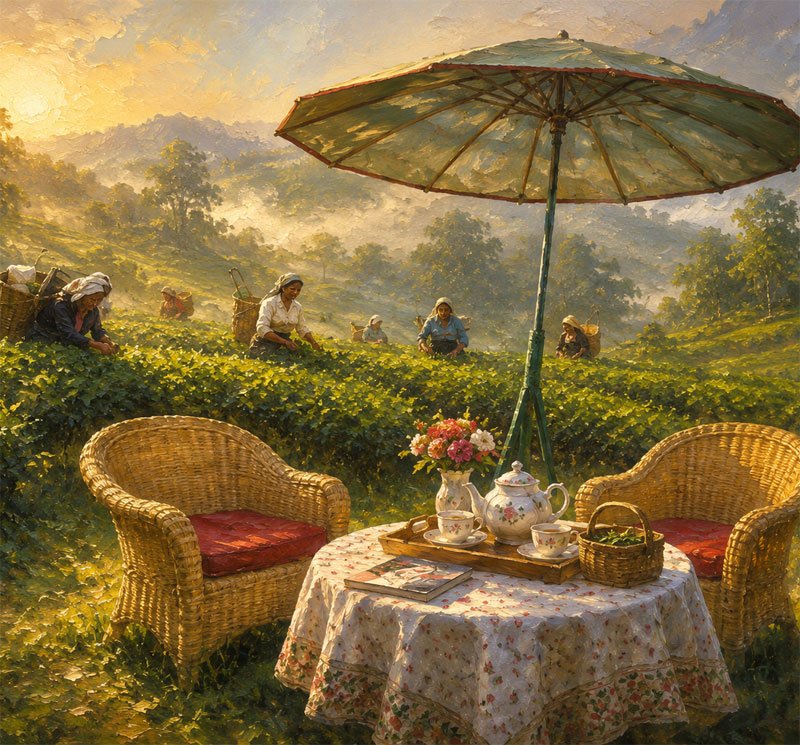
People, Plantations and the Changing World of Darjeeling's Tea Gardens
The tea gardens of Darjeeling are often admired for their beautiful landscapes. Neatly maintained rows of tea bushes follow the contours of the hills, while narrow paths wind through plantations towards factories, villages and old colonial bungalows. But behind this familiar landscape is a society that has developed over more than 150 years, shaped by migration, plantation work, colonial administration and generations of families whose lives remain closely connected with tea.
For much of this history, the tea garden was more than a workplace. It was a self-contained world. Workers lived in settlements known as labour lines, children grew up among the tea bushes, and families depended on the gardens for employment, housing and other essential services. At the other end of the social hierarchy, European planters lived in spacious bungalows, employed domestic staff and maintained a social life centred around their clubs and occasional visits to Darjeeling town.
The two worlds existed within the same estate, but they were separated by considerable differences in wealth, authority and opportunity.
Even today, when cities around Darjeeling have changed rapidly, many tea gardens retain a distinctive way of life. The working routines, settlements, family traditions and social relationships have evolved, but the pace of change has often been slower than in the towns and cities nearby.
To understand the life of a tea plucker is therefore to understand not only the work of harvesting tea, but also the history of the people and communities who made Darjeeling’s tea industry possible.
How the Tea Garden Communities Began
When commercial tea cultivation expanded in Darjeeling during the middle of the nineteenth century, the region had a relatively small population compared with the labour requirements of the growing plantations. Tea gardens needed a substantial workforce to clear and prepare land, plant and maintain bushes, construct factories and roads, and eventually pluck and process the leaves.
The colonial administration and private planters encouraged migration from neighbouring regions, particularly Nepal. Many of the migrants came from the eastern parts of Nepal, including communities such as the Rai, Limbu, Tamang, Gurung and Magar. Others came from different parts of the Himalayan region.
Migration was not simply a movement of individual workers. Entire families settled in the tea-growing areas, gradually establishing permanent communities around the estates. Over generations, these settlements became an important part of the social and cultural landscape of Darjeeling.
It is important to remember that the hills were not uninhabited before the arrival of the tea plantations. Lepcha communities, among others, had long-standing connections with the region. Bhutia and other communities were also part of the wider social landscape. The expansion of tea cultivation brought a new pattern of settlement and employment, adding to the region’s existing population.
For many migrants, working in a tea garden offered an opportunity to earn a regular income and establish a new life. Some were attracted by the possibility of access to housing, land for cultivation and other facilities associated with plantation employment. However, the opportunities came with dependence on the estate and the difficult conditions of plantation work.
The arrival of these communities transformed the demographic character of the hills. The Nepali-speaking population that developed around the tea plantations became an important part of what is now recognised as Darjeeling’s wider Gorkha social and cultural identity.
The Labour Line: A World Within the Tea Garden
One of the most distinctive features of a traditional tea estate is the labour line.
Labour lines are residential settlements built within or close to the plantation. In many gardens, houses are arranged in rows or clusters along narrow paths. They were originally established to accommodate plantation workers and their families, and over time became permanent settlements passed down through generations.
The houses were generally modest, traditionally built with locally available materials. Many had small courtyards or plots where families could grow vegetables, keep livestock or carry out household activities. Water points, paths, community spaces and other basic facilities formed part of everyday life.
The labour line was not simply a collection of workers’ houses. It developed into a close-knit community where neighbours were often relatives, where children grew up together and where festivals, marriages, funerals and other social occasions brought people together.
In many gardens, several generations of the same family have lived in the same settlement. Grandparents, parents and children may all have worked in the same estate, although younger generations increasingly look for opportunities outside the plantation.
The arrangement of the labour lines also reflected the structure of the plantation economy. The estate provided housing and certain facilities, while workers depended on the garden for employment. This created a relationship in which the workplace and the home were closely connected.
The Plantation Labour Act of 1951 subsequently established statutory responsibilities for plantation employers in areas such as housing, medical facilities, drinking water, sanitation and other welfare provisions. The implementation and quality of these facilities have varied considerably between estates.
For a visitor walking through a tea garden, the labour line offers a perspective that is often missing from the scenic image of the plantation. It is here that the daily life of the tea-growing community can be understood more clearly.
The Planter’s World: Life in the Colonial Bungalows
While workers lived in the labour lines, the British planters occupied a very different world.
The tea estates were often located far from the main towns. Roads were difficult, journeys were slow and communication with the outside world was limited. A planter and his family might spend much of the year living within the estate, surrounded by plantations, forests and small settlements.
The planter’s bungalow was the centre of this world. Usually built on a prominent site overlooking the garden, it was often a large residence with verandahs, high ceilings, gardens and separate quarters for domestic staff. Some bungalows were built in the nineteenth century and have survived, although many have been altered, abandoned or converted to other uses.
The bungalow was not merely a private residence. It was also an administrative centre from which the estate was managed. The planter received visitors, supervised operations and dealt with the senior staff who were responsible for the different departments of the garden.
The contrast between the planter’s residence and the labour lines was considerable. While the planter’s household could have several servants, the workers’ families often lived in modest accommodation and depended on the estate for many basic necessities.
The lifestyle of the British planter was influenced by the social conventions of colonial India. Hunting, fishing, riding, gardening, entertaining guests and sporting activities formed part of the recreational world of many planters. Their social life was also closely connected with other European planters and officials in the region.
For the British families who lived in these remote estates, maintaining a familiar social environment was important. This was one reason why planters’ clubs developed in Darjeeling and other tea-growing districts.
The Darjeeling Planters’ Club: A Social World of Its Own
One of the best-known institutions associated with the old planter community is the Darjeeling Planters’ Club.
The club opened in 1868 and became an important meeting place for planters working in the surrounding tea estates. According to historical accounts, the land on which it was built was donated by the Maharaja of Cooch Behar.
Before the widespread use of motor vehicles, planters and their wives travelled from their estates to Darjeeling on horseback. One account describes them making the journey towards the end of the month, often on the last Saturday, and staying in town over the weekend.
The club provided a place for members to meet, dine and socialise. It was a residential and dining club, reflecting the social habits of the European plantation community.
The club also reflected the social divisions of colonial society. Women were not admitted as members in its early years, and married men often stayed in boarding houses in town while using the club for social gatherings.
This is an interesting glimpse into a world that existed alongside the tea plantations but was quite separate from the everyday life of the workers.
The club was not simply a recreational facility. It was part of a wider network through which planters maintained relationships, exchanged information and preserved a shared social identity in an otherwise isolated working environment.
The Memsahib and the Planter’s Household
The life of the planter’s wife, commonly referred to as the memsahib, was another important part of plantation society.
Many women of British, Scottish and Irish backgrounds lived on the estates with their husbands. Their lives were shaped by the isolation of the plantations, the social expectations of colonial society and the availability of domestic staff.
Research by Supam Biswas, published in the University of North Bengal’s journal Karatoya, examines the lives of memsahibs in the tea industry of Darjeeling and Jalpaiguri during the nineteenth and twentieth centuries. It describes how some women established their own identities through writing, painting, travel, religious activity and philanthropy.
The planter’s household depended heavily on Indian domestic workers. Servants, cooks, gardeners, bearers and ayahs were part of the daily running of the bungalow. The employment of Indian women as ayahs and childcare workers was particularly common in European households.
The memsahib’s world was therefore connected to the plantation workforce in a different way from that of the male planter. Domestic workers often had close daily contact with the family, but the relationship still existed within the unequal social structure of colonial employment.
The old bungalows, their gardens and the surviving household objects are reminders of this particular chapter of Darjeeling’s social history.
The Relationship Between the Planter and the Workers
The relationship between the planter and the tea garden workers was central to the functioning of the estate.
The planter was not simply an employer in the modern sense. He was often the most powerful authority within the plantation, overseeing production, administration and the provision of basic facilities. Workers depended on the estate for employment and, in many cases, housing, access to medical care and other services.
The relationship was sometimes described through the expression mai-baap, suggesting a paternal or guardian-like role. Some planters took a personal interest in workers’ families, arranged assistance during illness, attended community occasions or supported local activities.
However, this paternal relationship should not be confused with equality. The planter held considerable authority, and workers had limited bargaining power. Wages were low by modern standards, working conditions were demanding and the estate controlled many aspects of everyday life.
Historical research on the plantation system describes these estates as relatively isolated enclaves where the authority of management extended well beyond the workplace. The combination of geographic isolation, economic dependence and limited access to alternative employment created a substantial imbalance between workers and management.
The relationship also varied from one garden to another and from one period to another. It would be inaccurate to describe every planter as either benevolent or oppressive. Individual experiences differed, but the underlying structure of the plantation economy remained unequal.
After independence, the British owners gradually gave way to Indian companies and business groups. Trade unions, labour laws and government oversight changed the relationship between workers and management. The old paternal system did not disappear overnight, but its authority had to accommodate new institutions and forms of representation.
A Day in the Life of a Tea Plucker
Tea plucking is physically demanding work that requires considerable skill and attention. The familiar standard of plucking two leaves and a bud is not simply a matter of removing the top of a tea bush. The plucker must select the appropriate shoots while avoiding coarse or unsuitable growth.
The working day generally begins in the morning. Workers gather at the designated collection points and proceed to their allotted sections of the garden. Depending on the estate and the time of year, the working routine may vary.
Tea pluckers carry baskets, traditionally supported by a strap across the forehead or shoulders, allowing both hands to remain free. They move along the rows of tea bushes, selecting tender shoots and placing them into the basket.
The work involves continuous bending, reaching and moving along uneven slopes. The hills can be wet and slippery, particularly during the monsoon. Workers may spend several hours outdoors in changing weather conditions.
The plucked leaves are collected and weighed according to the garden’s system. The quantity harvested, the quality of the shoots and the applicable wage arrangements all influence the worker’s earnings.
Women form a large proportion of the plucking workforce. Men are also employed in different activities, including pruning, digging, maintenance, factory operations, transport and supervisory work.
Tea plucking requires experience. An experienced worker can identify suitable shoots quickly and maintain a steady pace without damaging the bushes. The quality of the harvested leaf depends substantially on the care taken during this process.
The work is seasonal in its intensity. During periods of active growth, plucking becomes more frequent. At other times, the bushes require pruning, maintenance and rest before the next period of harvesting.
Women: The Backbone of Tea Plucking
The history of Darjeeling tea cannot be told without recognising the role of women.
Women have traditionally formed a substantial part of the plantation workforce, particularly in plucking. The work requires patience, speed and an ability to select suitable shoots consistently. Generations of women have developed this knowledge through years of experience.
Yet their responsibilities do not end when the working day is over. Many women return from the garden to cook, collect water, care for children and elderly family members, maintain their homes and undertake other household responsibilities.
This combination of paid plantation work and unpaid domestic labour has shaped the daily lives of women in the tea communities.
Women have also played important roles in preserving community traditions, organising festivals, maintaining family networks and passing cultural practices to younger generations.
Their contribution is not always visible in the finished packet of Darjeeling tea, but it is fundamental to the industry.
Festivals, Food and Community Life
Despite the demands of plantation work, tea garden communities have maintained a rich social and cultural life.
The Nepali-speaking population of Darjeeling includes several ethnic and cultural groups, each with its own traditions, festivals, music and food. Dashain and Tihar are widely celebrated, while Losar is observed by several Himalayan Buddhist communities. Other festivals and local occasions bring families and neighbours together throughout the year.
Community gatherings often take place in the labour lines or nearby settlements. Weddings, religious ceremonies and festivals are occasions when people who may be working in different parts of the garden come together.
Food is another important expression of community identity. Traditional dishes, locally grown vegetables, fermented foods, rice, lentils and meat preparations form part of everyday meals and festive occasions. The exact food traditions vary between communities and families.
Music and dance are also important. Folk traditions, community performances and modern Nepali music coexist, reflecting the changing cultural identity of the hills.
The labour line is therefore not merely a residential area. It is a place where cultural practices have been preserved, adapted and passed from one generation to the next.
Education and the Changing Aspirations of the Younger Generation
For many years, tea garden families depended heavily on plantation employment. Children grew up seeing their parents and grandparents working in the same garden, and it was common for successive generations to remain connected with the estate.
Education has gradually widened the choices available to younger people. Schools, colleges and access to towns have allowed some to pursue careers in teaching, government service, tourism, business and other occupations.
However, opportunities remain uneven. Distance from educational institutions, household income, transport and the availability of suitable jobs influence whether young people can pursue further education and employment outside the garden.
Many younger residents are increasingly reluctant to follow the same occupational path as their parents. Some migrate to Siliguri, Kolkata and other cities in search of work. Others find employment in tourism, hospitality, construction and the informal service sector.
This change has consequences for the tea gardens. The industry continues to depend on experienced workers, but the younger generation often has different expectations about wages, working conditions and future prospects.
Why Has Life in the Tea Gardens Changed More Slowly?
A visit to Darjeeling town or Siliguri reveals how rapidly urban life has changed. New buildings, vehicles, shops, communication technology and employment opportunities have transformed the way people live.
Many tea gardens, however, retain a noticeably different character.
The reasons are partly geographical and partly economic.
Tea estates are often located away from major roads and urban centres. The labour lines are closely tied to the plantation’s landholding and employment structure. In some gardens, the houses have remained in much the same locations for generations.
The local economy is also less diverse. While a town offers opportunities in trade, services, education, transport and industry, a tea garden may depend heavily on one principal employer. When the plantation performs well, employment and associated activities benefit. When it struggles or closes, the effects can be severe.
Housing is another important factor. Many families live in estate-provided accommodation, and improvements to houses and basic facilities depend on a combination of estate management, government responsibilities and the financial circumstances of the residents.
The result is a distinctive pattern of change. Mobile phones, television, motorcycles, improved clothing and modern consumer goods have reached many labour lines. At the same time, traditional housing patterns, dependence on plantation employment and older community relationships continue.
This does not mean that tea garden communities are untouched by modern life. Rather, modernisation has been uneven. Some aspects of daily life have changed quickly, while economic structures and living conditions have changed much more slowly.
When a Tea Garden Closes
The dependence of a community on a single plantation becomes particularly visible when a garden closes.
In recent years, some tea estates in the Darjeeling hills have experienced prolonged closures or serious operational difficulties. When regular employment disappears, families have to look for alternative sources of income.
A study published in 2024 by Dixchen Golay and Abdul Hannan examined livelihood practices in the closed Dooteriah, Kalej Valley and Peshok tea gardens. It found that former plantation workers had turned to activities such as subsistence cultivation, animal rearing, quarrying, agricultural labour, small shops, daily-wage work and employment under the rural employment guarantee programme. Some also migrated to distant towns and cities for informal-sector work.
This research illustrates how closely the economic security of a tea garden community remains connected with the functioning of the estate.
The consequences of closure extend beyond the loss of wages. Housing maintenance, access to services, children’s education and the everyday rhythm of the community can all be affected.
A tea garden is therefore not just a business. It is also the economic foundation of an entire settlement.
The Tea Garden Today
The tea gardens of Darjeeling have undergone considerable change since the colonial period. British planters have largely disappeared, ownership and management structures have changed, and workers now have access to trade unions, labour legislation and wider political institutions.
Yet the social landscape remains recognisable in many places. Old bungalows still stand above plantations. Labour lines continue to house generations of families. Women still form the backbone of the plucking workforce, and the seasonal rhythm of the tea garden continues to influence daily life.
There are also important differences between estates. Some have invested in accommodation, visitor facilities and new approaches to tea production. Others face difficulties related to infrastructure, wages, ageing bushes, changing markets and labour availability.
The younger generation is increasingly connected to the outside world, and many are seeking opportunities beyond plantation employment. At the same time, the cultural identity of the tea communities remains closely connected with the history of the gardens.
Looking Beyond the Tea Bushes
For visitors, a tea garden is often first experienced as a beautiful landscape. The rolling slopes, green bushes, mist-covered hills and distant mountain views make a lasting impression.
But the real story of Darjeeling tea is also found in its people.
The women who carefully select the tender shoots, the families who have lived in the labour lines for generations, the workers who maintain the bushes and factories, and the communities that have developed around the estates are all part of the history of the region.
A walk through a tea garden can reveal much more than the process of growing tea. It can offer an opportunity to understand how migration shaped the population of the hills, how colonial plantation society functioned, and how a distinctive community developed around an agricultural industry.
The story of Darjeeling tea is ultimately a human story. The familiar cup of tea carries within it the work, knowledge and history of the people who have tended these hills for generations.
Explore Darjeeling’s tea country with DarjeelingWalks
Walk through the tea gardens, learn about plantation history and discover the communities whose lives are connected with Darjeeling tea. Our experiences offer an opportunity to look beyond the landscape and understand the people and stories behind it.
Phone / WhatsApp: 9733000590